n8n Docker Setup: Why It Breaks (And the Easier Alternative)
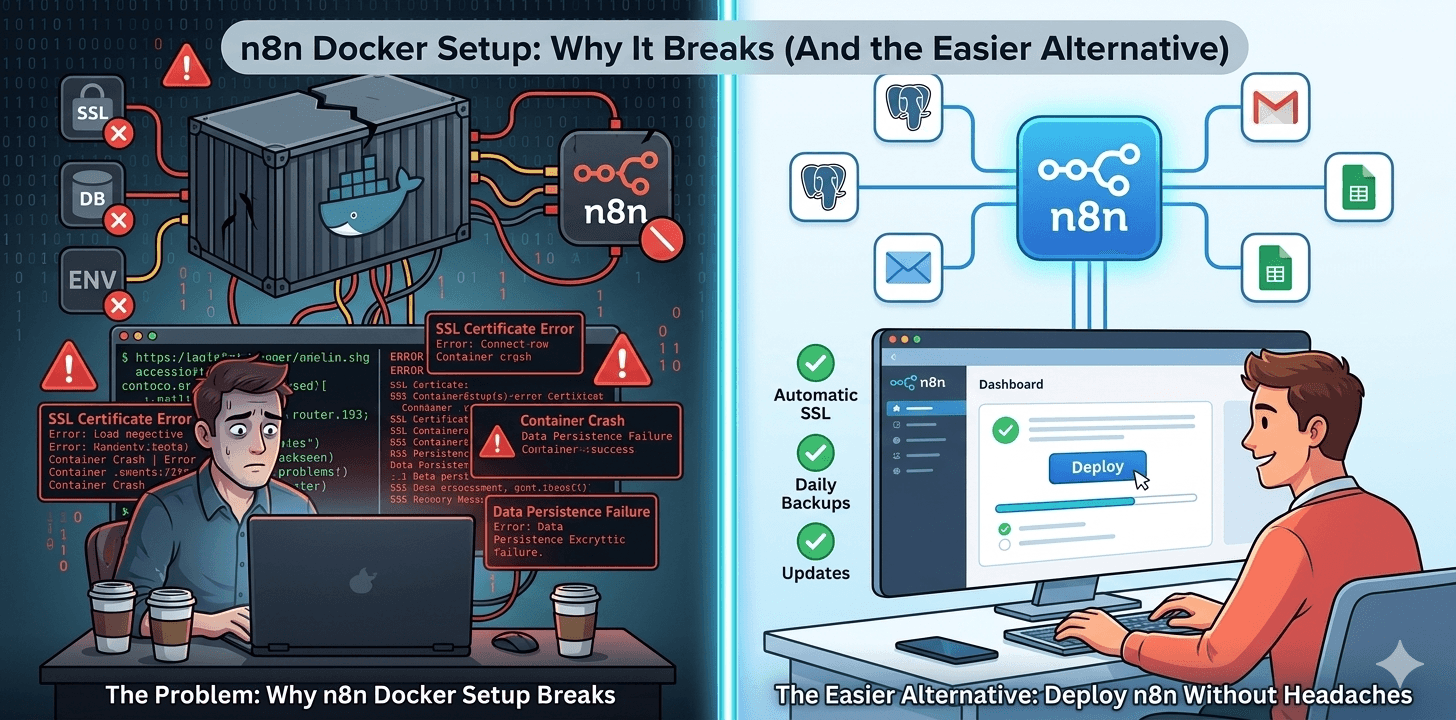
Key Takeaways (30‑Second Summary)
- Docker is the standard way – to self-host n8n, but setup is fraught with hidden pitfalls.
- The top 5 failure points – SSL certificate configuration, environment variable typos, database persistence, update chaos, and port conflicts.
- Most “it doesn’t work” moments – trace back to one of five specific misconfigurations.
- A working production setup – requires proper SSL, reverse proxy, persistent volumes, and the right environment variables.
- The easier alternative – Deploy n8n in minutes on Agntable with everything pre‑configured—no terminal, no debugging.
Why Docker for n8n?
Docker has become the standard way to self-host n8n – and for good reason.
Instead of installing n8n directly on your server (which requires manually setting up Node.js, managing dependencies, and dealing with version conflicts), Docker packages everything n8n needs into a single, isolated container. This approach offers several advantages:
- Isolation: n8n runs in its own environment, separate from other applications on your server.
- Portability: You can move your entire n8n setup to another server with minimal effort.
- Simplified updates: Upgrading n8n is often just a single command.
- Consistency: The same configuration works across development and production.
The official n8n documentation recommends Docker for self-hosting, and most tutorials – including those from Hostinger, KDnuggets, and community guides – follow this approach.
But here's what those tutorials don't tell you: Docker makes n8n easier to run, but not necessarily easier to set up correctly. The gap between “Docker is running” and “n8n is working securely with HTTPS and persistent data” is where most people get stuck.
The Real Problem: Why n8n Docker Setups Break
Search for “n8n docker setup”, and you'll find dozens of tutorials. Follow them exactly, and you'll probably get something running. But “running” isn't the same as “production‑ready.”
The real problems emerge when you try to:
- Access n8n securely over HTTPS.
- Keep your data when the container restarts.
- Configure n8n for your specific needs.
- Update to a newer version without breaking everything.
- Connect to external services that require custom certificates.
One developer documented their painful update experience on LinkedIn: “I broke everything trying to update n8n. Multiple docker-compose.yml files in different folders, outdated images tagged as <none>, conflicts between different image registries, containers running from different images than I thought.”
This isn't an isolated story. Based on community discussions, GitHub issues, and forum posts, this article walks through the five most common failure points – and how to fix each one.
Failure Point #1: The SSL Certificate Maze
You visit your n8n instance and see “Not Secure” in the browser, or worse – you can't access it at all. Webhooks fail. You see ERR_CERT_AUTHORITY_INVALID or “secure cookie” warnings.
Why it happens: n8n requires HTTPS to function properly – especially for webhooks, which are the backbone of most automations. But setting up SSL with Docker is surprisingly complex:
- You need a domain name pointed to your server. (Our n8n VPS vs managed hosting walks through the full server provisioning process, including domain configuration and initial hardening.)
- You need a reverse proxy (Nginx, Caddy, or Traefik) to handle HTTPS traffic.
- You need Let's Encrypt certificates configured and set to auto‑renew.
- You need to configure the reverse proxy to forward traffic to the n8n container.
- You need to ensure WebSocket connections work for the n8n editor.
One forum user reported: “I configured SSL with Certbot, but n8n still showed as insecure. The certificate was valid, but something wasn't connecting properly.” This is typically a reverse proxy configuration issue – the traffic is encrypted to the proxy, but the proxy isn't correctly forwarding to n8n.
The fix: A proper reverse proxy setup with correct headers. Here's a working Nginx configuration:
server {
  listen 443 ssl;
  server_name n8n.yourdomain.com;

  ssl_certificate /etc/letsencrypt/live/n8n.yourdomain.com/fullchain.pem;
  ssl_certificate_key /etc/letsencrypt/live/n8n.yourdomain.com/privkey.pem;

  location / {
    proxy_pass http://localhost:5678;
    proxy_set_header Host $host;
    proxy_set_header X-Real-IP $remote_addr;
    proxy_set_header X-Forwarded-For $proxy_add_x_forwarded_for;
    proxy_set_header X-Forwarded-Proto $scheme;

    # WebSocket support (critical for n8n editor)
    proxy_http_version 1.1;
    proxy_set_header Upgrade $http_upgrade;
    proxy_set_header Connection "upgrade";
  }
}

server {
  listen 80;
  server_name n8n.yourdomain.com;
  return 301 https://$host$request_uri;
}
Even with this configuration, you still need to ensure the certificates renew automatically (Certbot handles this, but only if configured correctly) and that your firewall allows traffic on ports 80 and 443.
Failure Point #2: Environment Variable Hell
n8n starts but behaves strangely. Webhooks don't work. Authentication fails. External services can't connect. Or n8n won't start at all, with cryptic error messages.
Why it happens: n8n relies heavily on environment variables for configuration. A single typo – or missing variable – can break critical functionality.
Commonly Misconfigured Environment Variables
| Variable | Purpose | Common Mistake |
|---|---|---|
N8N_HOST | Defines the hostname n8n runs on | Setting to localhost or 0.0.0.0 instead of your actual domain |
N8N_PROTOCOL | HTTP or HTTPS | Forgetting to set to https when using SSL |
WEBHOOK_URL | Public URL for webhooks | Not setting this, causing webhook failures |
N8N_ENCRYPTION_KEY | Encrypts credentials in the database | Using a weak key or not setting it at all |
DB_TYPE | Database type (sqlite/postgresdb) | Not set for production use |
N8N_BASIC_AUTH_* | Basic authentication | Setting incorrectly, locking yourself out |
One GitHub issue documented a particularly frustrating case: a developer spent hours trying to connect n8n to a PostgreSQL database with a custom CA certificate, only to find that the Postgres node wasn't respecting the system trust store or environment variables.
The fix: Use a .env file to manage variables cleanly. Here's a production-ready example:
# Domain configuration
N8N_HOST=n8n.yourdomain.com
N8N_PROTOCOL=https
WEBHOOK_URL=https://n8n.yourdomain.com/

# Security
N8N_ENCRYPTION_KEY=your-base64-32-char-key-here   # Generate with: openssl rand -base64 32
N8N_BASIC_AUTH_ACTIVE=true
N8N_BASIC_AUTH_USER=admin
N8N_BASIC_AUTH_PASSWORD=your-secure-password

# Database (PostgreSQL for production)
DB_TYPE=postgresdb
DB_POSTGRESDB_HOST=postgres
DB_POSTGRESDB_PORT=5432
DB_POSTGRESDB_USER=n8n
DB_POSTGRESDB_PASSWORD=your-db-password
DB_POSTGRESDB_DATABASE=n8n

# Optional: JWT secret for multi-main setups
# N8N_USER_MANAGEMENT_JWT_SECRET=your-jwt-secret

# Timezone
GENERIC_TIMEZONE=America/New_York
Then reference this file in your docker-compose.yml using the env_file directive.
Failure Point #3: Database & Data Persistence Pitfalls
You restart your n8n container, and all your workflows disappear. Or n8n crashes with database errors. Or performance degrades over time.
Why it happens: By default, n8n stores data inside the container. When the container is removed (during updates or restarts), that data vanishes. This is the number one data loss scenario for new n8n users.
The official n8n Docker documentation warns: “If you don't manually configure a mounted directory, all data (including database.sqlite) will be stored inside the container. Once the container is deleted or rebuilt, the data will be completely lost.”
Even when you configure persistent volumes, permission issues can arise. The n8n container runs as user ID 1000 (the node user), so the mounted directory must be writable by that user:
sudo chown -R 1000:1000 ./n8n-dataFor production workloads, SQLite (the default) has limitations with concurrent writes. If you expect heavier workloads or multiple concurrent executions, n8n queue mode is usually the next step because it separates execution from the main app and scales more cleanly. One comprehensive guide notes: “Use PostgreSQL or MySQL as your production database to avoid SQLite's concurrency issues.”
The fix: Use a Docker Compose configuration with proper persistence and PostgreSQL:
version: '3.8'

services:
  postgres:
    image: postgres:15-alpine
    restart: unless-stopped
    environment:
      - POSTGRES_USER=n8n
      - POSTGRES_PASSWORD=${DB_POSTGRESDB_PASSWORD}
      - POSTGRES_DB=n8n
    volumes:
      - ./postgres-data:/var/lib/postgresql/data
    networks:
      - n8n-network
    healthcheck:
      test: ["CMD-SHELL", "pg_isready -U n8n"]
      interval: 30s
      timeout: 10s
      retries: 5

  n8n:
    image: n8nio/n8n:latest
    restart: unless-stopped
    ports:
      - "127.0.0.1:5678:5678"  # Local-only access
    env_file:
      - .env
    volumes:
      - ./n8n-data:/home/node/.n8n
    networks:
      - n8n-network
    depends_on:
      postgres:
        condition: service_healthy

networks:
  n8n-network:
    driver: bridge
This configuration:
- Uses PostgreSQL for better concurrency.
- Mounts volumes for persistent data.
- Only exposes n8n locally (relying on reverse proxy for external access).
- References environment variables from a
.envfile.
Failure Point #4: The Update Nightmare
You run docker compose pull && docker compose up -d to update n8n, and suddenly nothing works. The old version still shows. Containers crash. Data appears corrupted.
Why it happens: Updating Docker containers seems simple, but several things can go wrong:
- Wrong directory: You run the update command in the wrong folder, updating the wrong instance.
- Image registry confusion: Multiple n8n image sources (
n8nio/n8nvsdocker.n8n.io/n8nio/n8n). - Stale images: Old images tagged as
<none>are consuming space and are confusing. - Orphaned containers: Previous containers still running on old images.
- Database migrations: New n8n versions may require database schema updates that don't run automatically.
One developer's cautionary tale: “I got hit by weird errors like WorkflowActivationError invalid_union_discriminator from the collaboration service. Caddy reverse proxy certs expired. Rebuilt configs. Broke again.”
The fix: A safe update process requires multiple steps. Here's a script that does it right:
#!/bin/bash
# update-n8n.sh - Safe update script

echo "📦 Backing up n8n data..."
tar -czf "n8n-backup-$(date +%Y%m%d-%H%M%S).tar.gz" ./n8n-data ./postgres-data

echo "🔄 Pulling latest images..."
docker compose pull

echo "🔄 Recreating containers..."
docker compose down
docker compose up -d --force-recreate

echo "✅ Update complete. Check logs: docker compose logs -f"
Even with this process, you may encounter issues if the new version requires database migrations. Some updates break compatibility with custom nodes or existing workflows. Always test in a staging environment first.
Failure Point #5: Port & Network Conflicts
The n8n container starts, but you can't access it. Or another application stops working. Or you get “port already in use” errors.
Why it happens: The classic port mapping 5678:5678 exposes n8n directly on your server's IP. This creates several problems:
- Port conflicts: Another service might already use port 5678.
- Security risk: n8n is exposed to the internet without SSL (or before SSL is configured).
- No clean upgrade path: When you add SSL later, you must reconfigure everything.
The fix: Only expose n8n locally, then use a reverse proxy for external access:
ports:
  - "127.0.0.1:5678:5678"  # Only accessible from the same machine
The Working Solution: A Proper Production Setup
After all these failure points, you might wonder: what does a working setup actually look like?
Here's a complete, production‑ready configuration that addresses all the issues above.
Directory Structure
n8n-docker/
├── .env                    # Environment variables (keep secure!)
├── docker-compose.yml      # Service configuration
├── n8n-data/               # n8n persistent data (chown 1000:1000)
├── postgres-data/          # PostgreSQL persistent data
└── backups/                # Automated backups
.env File
# Domain
N8N_HOST=n8n.yourdomain.com
N8N_PROTOCOL=https
WEBHOOK_URL=https://n8n.yourdomain.com/

# Security
N8N_ENCRYPTION_KEY=your-base64-32-char-key-here   # openssl rand -base64 32
N8N_BASIC_AUTH_ACTIVE=true
N8N_BASIC_AUTH_USER=admin
N8N_BASIC_AUTH_PASSWORD=your-secure-password

# Database
DB_TYPE=postgresdb
DB_POSTGRESDB_HOST=postgres
DB_POSTGRESDB_PORT=5432
DB_POSTGRESDB_USER=n8n
DB_POSTGRESDB_PASSWORD=your-db-password
DB_POSTGRESDB_DATABASE=n8n

# Timezone
GENERIC_TIMEZONE=America/New_York
Docker-compose.yml
version: '3.8'

services:
  postgres:
    image: postgres:15-alpine
    restart: unless-stopped
    environment:
      - POSTGRES_USER=n8n
      - POSTGRES_PASSWORD=${DB_POSTGRESDB_PASSWORD}
      - POSTGRES_DB=n8n
    volumes:
      - ./postgres-data:/var/lib/postgresql/data
    networks:
      - n8n-network
    healthcheck:
      test: ["CMD-SHELL", "pg_isready -U n8n"]
      interval: 30s
      timeout: 10s
      retries: 5

  n8n:
    image: n8nio/n8n:latest
    restart: unless-stopped
    ports:
      - "127.0.0.1:5678:5678"  # Local-only access
    env_file:
      - .env
    volumes:
      - ./n8n-data:/home/node/.n8n
    networks:
      - n8n-network
    depends_on:
      postgres:
        condition: service_healthy

networks:
  n8n-network:
    driver: bridge
Reverse Proxy Configuration (Nginx)
server {
  listen 443 ssl http2;
  server_name n8n.yourdomain.com;

  ssl_certificate /etc/letsencrypt/live/n8n.yourdomain.com/fullchain.pem;
  ssl_certificate_key /etc/letsencrypt/live/n8n.yourdomain.com/privkey.pem;

  location / {
    proxy_pass http://127.0.0.1:5678;
    proxy_http_version 1.1;
    proxy_set_header Host $host;
    proxy_set_header X-Real-IP $remote_addr;
    proxy_set_header X-Forwarded-For $proxy_add_x_forwarded_for;
    proxy_set_header X-Forwarded-Proto $scheme;
    proxy_set_header Upgrade $http_upgrade;
    proxy_set_header Connection "upgrade";
  }
}

server {
  listen 80;
  server_name n8n.yourdomain.com;
  return 301 https://$host$request_uri;
}
The Easier Alternative: Deploy n8n Without the Headaches
After reading through all these failure points and the complex production setup, you might be thinking: “There has to be a better way.”
But there is.
Agntable was built specifically to solve these exact problems. We took every pain point documented in this article – SSL configuration, environment variables, database persistence, updates, monitoring – and built a platform that handles them automatically. Here's what deploying n8n on Agntable looks like:
Minute 1: Visit Agntable, select n8n from the catalogue, and choose your plan (Starter at $9.99, Pro at $24.99, or Business at $49.99). Name your instance.
Minute 2: Click “Deploy.” Behind the scenes, we:
- Provide a dedicated, isolated environment with guaranteed resources.
- Configure PostgreSQL with optimised settings for n8n.
- Generate and install SSL certificates automatically.
- Set up daily verified backups.
- Enable 24/7 monitoring with auto-recovery.
- Configure firewall rules with sane defaults.
Minute 3: You receive a live HTTPS URL – yourname.agntable.cloud. Log in and start building workflows. SSL works. Backups are running. Security patches will apply automatically after testing.
DIY Docker vs Agntable
| What You Get | DIY Docker | Agntable |
|---|---|---|
Setup time | 5–24 hours | 3 minutes |
SSL configuration | Manual, error-prone | Automatic, included |
Database | You configure | PostgreSQL pre-optimised |
Backups | You script and verify | Daily, verified |
Updates | Manual, risky | Automatic, tested |
Monitoring | You set up | 24/7 with auto-recovery |
Support | Community forums | Real humans who know n8n |
Monthly cost (including your time) | $150–$500+ | $9.99 to $49.99 flat |
Frequently Asked Questions
1. What's the minimum server spec for n8n with Docker?
n8n officially recommends a minimum of 2GB RAM and 1 vCPU for production use. A 1GB RAM server will run n8n but may become unstable under load, especially with complex workflows.
2. Can I use SQLite for production n8n?
Technically, yes, but it's not recommended. SQLite has concurrency limitations that can cause issues with multiple simultaneous workflow executions. For production workloads, use PostgreSQL.
3. How do I back up my n8n Docker instance?
At minimum, back up your data directory (./n8n-data) and your database (if using PostgreSQL). For SQLite, just back up the database file. Always test your backups by restoring to a test environment.
4. Why do I need a domain name for n8n?
n8n webhooks require a publicly accessible URL. While you can run n8n on an IP address, SSL certificates (required for webhooks) need a domain. Also, many external services require domain-based webhook URLs.
5. How often should I update n8n?
n8n releases updates frequently. For security reasons, you should update at least monthly. Always back up before updating and test in a staging environment first.
6. Can I install custom npm packages in n8n Docker?
Yes, but it requires building a custom Docker image. You'll need to create a Dockerfile that extends the official n8n image and installs additional packages. This adds another layer of maintenance complexity.
7. What's the difference between n8n Cloud and self-hosted n8n on Docker?
n8n Cloud is fully managed – you pay per execution and don't touch infrastructure. Self-hosted n8n on Docker gives you unlimited executions for a fixed server cost, but you handle all maintenance. Managed hosting platforms like Agntable offer the best of both: unlimited executions with zero infrastructure work.
8. How do I fix permission issues with mounted volumes?
The n8n container runs as user ID 1000. Ensure your mounted directory is owned by that user: sudo chown -R 1000:1000 ./n8n-data.
9. What environment variables are essential for HTTPS?
You must set N8N_PROTOCOL=https and WEBHOOK_URL=https://yourdomain.com/ (with trailing slash). Also, ensure N8N_HOST matches your domain.
Conclusion: Build Workflows, Not Infrastructure
The Docker setup for n8n is a classic example of the open-source trade-off: incredible power and flexibility, but significant operational complexity.
If you're a developer who genuinely enjoys infrastructure work, the DIY Docker route can be rewarding. You'll learn about containers, reverse proxies, SSL, and database management. You'll have complete control over every aspect of your n8n instance.
But if you're like most n8n users – whether you're a founder automating your business, a marketer building lead flows, or an operations professional streamlining processes – you probably don't want to become a part-time sysadmin.
You want to build workflows. You want to connect apps. You want to save time, not spend it debugging Nginx configurations at 2 AM.
That's why Agntable exists. We handle the infrastructure so you can focus on the automation. Your n8n instance deploys in three minutes with SSL, backups, monitoring, and updates all handled automatically. You get the unlimited executions and data control of self-hosting without any of the maintenance headaches.
Ready to stop debugging Docker and start building? Deploy n8n on Agntable in minutes. 7-day money-back guarantee.
👉 Deploy N8N – no servers, no terminal, no DevOps. Just n8n, up and running.